Installing a CCTV system is a vital step in protecting your business premises, staff, and assets. Yet, for many responsible owners, this powerful security tool comes with a nagging uncertainty. Navigating the complex web of business cctv regulations uk can feel overwhelming, sparking concerns about GDPR, employee privacy rights, and the risk of substantial fines for non-compliance. This confusion often leaves you questioning whether your security measures are a true safeguard or a potential liability.
This complete 2025 compliance guide is designed to replace that uncertainty with confidence. We provide a clear, straightforward roadmap to understanding your legal obligations under the Data Protection Act and GDPR. Inside, you’ll find an actionable checklist to ensure your system is fully compliant, from correct signage to handling data requests lawfully. Let us be your trusted partner in security, helping you protect your business effectively while achieving complete peace of mind.
The Legal Foundations: Why CCTV is Governed by Data Protection Law
Installing a security system is a proactive step towards protecting your premises, but it’s crucial to understand that modern surveillance involves more than just hardware. The moment your Closed-circuit television (CCTV) system captures footage of an identifiable person, you are processing ‘personal data’. This simple fact places your business directly under the governance of UK data protection law, making compliance a legal necessity, not an option.
Understanding these foundational rules is the first step towards operating your system responsibly. Adhering to the established business cctv regulations uk not only protects the privacy of your staff and customers but also safeguards your business from significant legal and financial penalties, reinforcing trust and professionalism.
UK GDPR and the Data Protection Act 2018 Explained
The primary legal frameworks you must follow are the UK General Data Protection Regulation (UK GDPR) and the Data Protection Act 2018. These laws dictate how organisations handle personal data. For CCTV, this includes images of individuals, their movements, and even vehicle registration numbers. The legislation is built on several core principles you must uphold:
- Lawfulness, Fairness, and Transparency: You must have a clear, legitimate reason for using CCTV and be transparent about it (e.g., through clear signage).
- Purpose Limitation: Data can only be used for the specific and explicit purpose you have identified, such as preventing crime. It cannot be used for other, unrelated reasons.
- Data Minimisation: You should only capture the minimum amount of footage necessary to achieve your stated purpose. Avoid placing cameras in areas where privacy is expected, like changing rooms or toilets.
Your Role as a ‘Data Controller’
As a business that decides to install and operate a CCTV system, you are defined as a ‘data controller’. This legal term means you have the ultimate responsibility for how personal data is collected, stored, used, and deleted. Under the ‘accountability’ principle of UK GDPR, the burden of proof is on you to demonstrate that your system is fully compliant. This means you are answerable for every stage of the data’s lifecycle, from a camera’s positioning to how you respond to data access requests.
The ICO: The UK’s Data Protection Watchdog
The Information Commissioner’s Office (ICO) is the UK’s independent authority responsible for enforcing data protection law. The ICO provides comprehensive guidance to help organisations comply with their obligations and investigates complaints from the public. Crucially, it has the power to take enforcement action, including issuing substantial fines for serious breaches. For businesses, this underscores the importance of treating data protection not as a bureaucratic hurdle, but as a core component of responsible security management.
A Practical Checklist: Your Core Legal Obligations
Navigating the legal landscape of commercial surveillance can feel complex, but meeting your core obligations is straightforward with a structured approach. This practical checklist breaks down the essential steps required to ensure your system is fully compliant with UK data protection laws. Following these foundational requirements is key to operating your system responsibly and avoiding significant penalties. For a complete overview, you can always consult the official UK government’s data protection rules for CCTV, which outline your fundamental duties as a business owner.
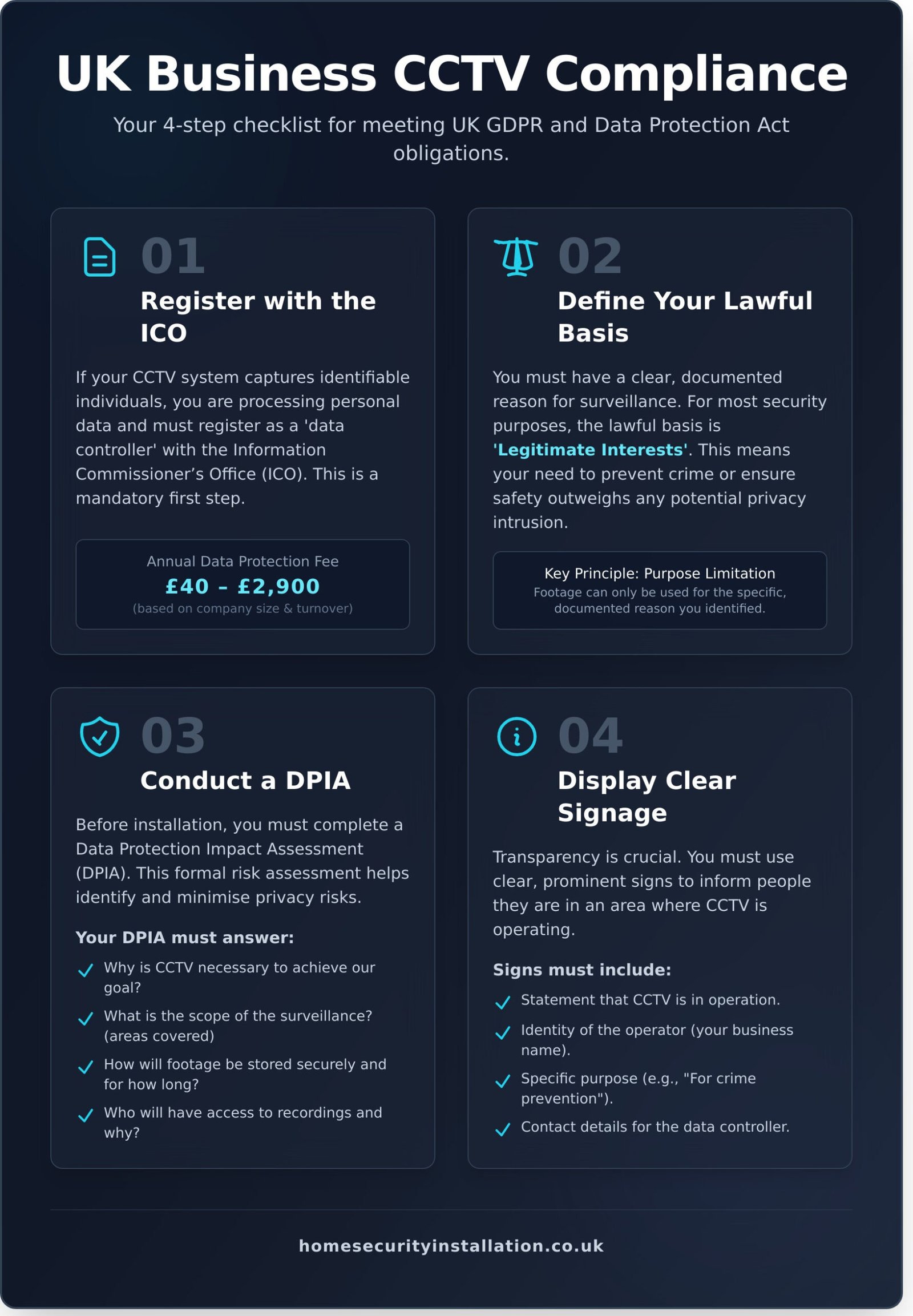
1. Register with the ICO and Pay the Fee
If your CCTV system will capture images of identifiable individuals-including staff, customers, or the public-you are processing personal data. This means you must register with the Information Commissioner’s Office (ICO). An annual data protection fee is required, which typically ranges from £40 to £2,900, depending on your company’s size and turnover. Failing to register can lead to substantial fines, so this is a non-negotiable first step. The ICO provides a self-assessment tool on its website to help you determine if you need to register.
2. Establish and Document Your Lawful Basis
You cannot operate CCTV without a clear, valid reason. Under GDPR, this is known as your “lawful basis for processing.” For most security applications, the lawful basis is ‘legitimate interests’. This means you have a genuine and necessary reason to use surveillance, such as preventing crime or ensuring health and safety, which outweighs any potential privacy intrusion. Crucially, you must document this purpose clearly before you begin recording.
3. Conduct a Data Protection Impact Assessment (DPIA)
Before installing your system, you must conduct a DPIA. This is a formal risk assessment that helps you identify and minimise the data protection risks associated with your CCTV. It forces you to think critically about your surveillance and demonstrates compliance. Your DPIA should answer key questions, including:
- Why is CCTV necessary to achieve our objective?
- What is the scope of the surveillance (e.g., which areas are covered)?
- How will footage be stored securely and for how long?
- Who will have access to the recordings and why?
4. Display Clear and Compliant Signage
One of the most critical aspects of compliant business cctv regulations uk is transparency. You must use clear, visible signs to inform people that they are in an area where surveillance is taking place. These signs must be prominent and easy to understand. At a minimum, your signage must include:
- A clear statement that CCTV is in operation.
- The identity of who is operating the system (your business name).
- The specific purpose of the surveillance (e.g., “For the prevention of crime”).
- Contact details for the data controller (your business) for any enquiries.
Managing CCTV Footage: A Secure Data Lifecycle
Once your CCTV system is operational, managing the recorded footage becomes a critical responsibility. Simply recording video is not enough; you must handle that data in a way that is secure, transparent, and compliant with UK GDPR. Following professional best practices for the entire data lifecycle-from capture to deletion-ensures you meet your legal duties and maintain trust.
Handling Subject Access Requests (SARs)
Under UK data protection law, individuals have the right to request a copy of any personal data you hold on them, including CCTV footage. When you receive a Subject Access Request (SAR), you must respond without undue delay and within one calendar month. You are obligated to provide the footage of the individual, but you must also protect the privacy of any other people visible by redacting or blurring their images. A request can only be refused in very limited circumstances, such as if it would compromise an active police investigation.
Secure Storage and Access Control
Protecting your footage from unauthorised access is fundamental to compliance. Your security measures should be both digital and physical. This is a core component of the business cctv regulations uk businesses must follow. We recommend implementing:
- Digital Security: Use strong, unique passwords for your recording system and enable encryption where available to protect data both in storage and during transmission.
- Access Control: Limit access to live and recorded footage to a small number of trained, authorised personnel. Keep a detailed log of who has accessed footage, noting the date, time, and reason.
- Physical Security: Ensure your DVR or NVR recording unit is kept in a secure, locked cabinet or room to prevent tampering or theft.
Creating a Data Retention Policy
You cannot keep CCTV recordings indefinitely. The principle of ‘storage limitation’ means you should only retain footage for as long as is necessary for the specific purpose you identified. A typical retention period for most businesses is 30 days. It is vital to document this policy and ensure your system is configured to automatically overwrite old footage. For detailed advice on setting appropriate timescales, the official Information Commissioner’s Office (ICO) guidance is an essential resource.
Sharing Footage with Police and Third Parties
There are strict rules about sharing footage. If the police request footage to prevent or detect crime, you can share it, but you should always verify their identity and ask for a formal data request form. This creates a clear audit trail. Crucially, you must never share footage with unauthorised third parties or post clips on social media, as this constitutes a serious data breach and undermines the integrity of your security system.
The Specifics of Monitoring Employees with CCTV
Using CCTV to monitor employees is one of the most sensitive areas of surveillance, requiring a careful and considered approach. Unlike members of the public, your staff have a greater expectation of privacy in their workplace. Getting this wrong can lead to serious legal challenges and a breakdown in trust. The core principles that must guide your decisions are justification, proportionality, and transparency.
Justification and Proportionality in the Workplace
Before installing any camera that could monitor staff, you must have a very strong, documented reason. General performance monitoring or checking on productivity is rarely, if ever, justifiable. Instead, your purpose must relate to a specific and serious concern, such as:
- Investigating suspected criminal activity, like theft or vandalism.
- Ensuring compliance with critical health and safety procedures in high-risk areas.
- Protecting staff in public-facing roles from potential aggression.
Crucially, you must be able to prove that CCTV is a necessary and proportionate response, and that no less intrusive method could achieve the same objective.
Informing Your Staff: Transparency is Key
Openness is a legal requirement. Covert monitoring is unlawful except in the most exceptional circumstances (such as a specific criminal investigation) and requires high-level authorisation. For all other staff monitoring, you must inform your employees clearly. The best practice is to include a detailed CCTV policy in your staff handbook that outlines:
- The exact locations of all cameras.
- The specific purpose for monitoring in each area.
- Who has access to the footage and under what circumstances.
- Your data retention period for the recordings.
Restricted Areas and Unacceptable Monitoring
Certain areas of the workplace have a very high expectation of privacy where surveillance is almost never acceptable. Cameras are strictly prohibited in toilets, shower facilities, and changing rooms. Furthermore, installing cameras in staff break rooms, canteens, or private offices is highly intrusive and requires an exceptionally strong justification. Using footage to monitor timekeeping, measure break lengths, or track productivity is a misuse of the system and a clear breach of data protection principles. Adhering to these specific business cctv regulations UK protects both your staff and your business from legal risk.
Ensuring your system is compliant provides complete peace of mind. For expert advice on designing and installing a system that meets all legal requirements, talk to one of our certified UK professionals.
Choosing and Installing a Compliant CCTV System
Understanding the legal framework is the first step, but true compliance is achieved through practical choices in hardware and installation. The right system, installed correctly, not only enhances your security but also integrates data protection into its very design, giving you complete peace of mind.
Camera Placement and Minimising Intrusion
The placement of your cameras is one of the most critical factors in meeting your legal obligations. Each camera should have a clear, justifiable purpose and be positioned to capture only the specific area required for that purpose. It is essential to angle cameras to avoid intruding on areas where individuals have a reasonable expectation of privacy. This includes neighbouring homes and gardens, as well as private spaces within your own premises like changing rooms or toilets. Capturing public pavements or streets should be minimised and only done when absolutely necessary for your stated security purpose.
Why Professional Installation is a Compliance Asset
While a DIY approach may seem cost-effective, a professional installation is an investment in getting your compliance right from the start. Navigating the nuances of business cctv regulations uk is significantly easier with an expert partner who ensures your system is both effective and lawful.
- Correct Camera Angles: Certified installers are trained to position and angle cameras to maximise security coverage while respecting privacy boundaries, reducing the risk of accidental data breaches.
- Secure and Reliable Setup: Professionals ensure that all equipment is securely mounted and wired, protecting it from tampering and ensuring system reliability.
- Expert Guidance: An installer can provide essential initial training on how to operate your system in a compliant manner, from setting retention periods to managing user access.
System Features That Support Data Protection
Modern CCTV technology includes advanced features specifically designed to simplify data protection and help you adhere to business cctv regulations uk. When selecting a system, look for functionalities that make compliance straightforward:
- Privacy Masking: This allows you to digitally block out specific areas within a camera’s field of view, such as a neighbour’s window or a payment terminal’s PIN pad, ensuring they are not recorded.
- User Access Logs: A system that logs who has viewed or exported footage, and when, provides a crucial audit trail for accountability.
- Secure Data Export: The ability to easily and securely export specific clips is vital for responding to Subject Access Requests (SARs) without sharing unnecessary data.
By choosing the right technology and relying on expert installation, you can build a security system that protects your business and respects data protection law. Talk to our experts about a professionally installed, compliant system.
Navigating CCTV Compliance: Your Final Steps to Peace of Mind
Understanding the legal landscape for commercial surveillance is crucial for any responsible UK business owner. As we’ve covered, compliance goes far beyond the initial installation. It involves a deep understanding of data protection principles, maintaining a secure lifecycle for all recorded footage, and establishing clear, transparent policies, particularly regarding employee monitoring. Mastering these elements is not just about avoiding fines; it’s about building trust and operating with integrity.
Ultimately, adhering to the current business cctv regulations uk is a non-negotiable part of modern security management. But you don’t have to navigate this complex area alone. Founded in 1980, our team brings decades of experience to the table. Our certified UK professionals are experts in designing and installing customised, fully compliant CCTV solutions that provide both robust protection and complete peace of mind.
Let us help you secure your premises the right way. Ensure your business is protected and compliant. Request a free CCTV consultation today.
Making the right choice in security is the smartest investment for your business’s future.
Frequently Asked Questions
Can my business CCTV system record audio in the UK?
Generally, recording audio with your business CCTV is not permitted and is highly intrusive. While video surveillance is used for security, audio recording captures private conversations, which is rarely justifiable under UK data protection law. You must have an exceptionally strong, specific reason for the recording, and individuals must be explicitly informed that audio is being captured before they enter the area. For most businesses, audio recording presents a significant compliance risk.
Are hidden cameras ever legal to use in a UK business?
Covert or hidden cameras are only legal in very rare and specific circumstances, such as investigating suspected criminal activity like theft by an employee. They cannot be used for general monitoring of staff or customers. Using hidden cameras requires a robust justification, must be targeted and time-limited, and should only be considered as a last resort. It is a complex area, and we strongly advise seeking expert legal guidance before proceeding with any covert surveillance.
What are the specific regulations for using CCTV in company vehicles?
When using CCTV in company vehicles, you must inform drivers, and potentially passengers, that they are being recorded, typically with clear signs or stickers inside the vehicle. The recording must have a legitimate and clearly defined purpose, such as ensuring driver safety, investigating accidents, or protecting company assets. If the vehicle is also used for personal time, the system should not record during those periods to respect the employee’s right to privacy.
Do these data protection rules apply to my small shop with just one camera?
Yes, the rules apply to any business, regardless of size. If your camera captures and stores images of identifiable people, you are processing personal data and must comply with UK GDPR and the Data Protection Act. This means having a clear legal basis for recording, displaying visible signage, and managing the data securely. Following the correct business cctv regulations uk is essential for every organisation, from a single small shop to a large corporation.
How do I correctly blur or redact other people from footage before sharing it?
To protect the privacy of third parties, you must redact or blur their images before sharing footage, for instance, when responding to a data request. This can be done using video editing software with motion-tracking capabilities to obscure faces and other identifying features like clothing or vehicle number plates. Given the importance of getting this right, many businesses choose a professional redaction service to ensure full compliance and complete peace of mind.
What are the potential penalties for failing to comply with UK CCTV regulations?
Failing to comply with UK CCTV regulations can result in severe penalties from the Information Commissioner’s Office (ICO). Fines can be substantial, reaching up to £17.5 million or 4% of your company’s annual global turnover, whichever is greater. Beyond financial penalties, non-compliance can also lead to serious reputational damage and private legal action from affected individuals. Proper adherence to business cctv regulations uk is a critical part of risk management.
Do I need to put up signs if the cameras are only inside my office?
Yes, you are legally required to display clear and prominent signs even if cameras are only used internally. Staff, clients, and any visitors have the right to know they are being monitored before they enter a recorded area. Your signs should clearly state that CCTV is in operation, explain the purpose of the surveillance (e.g., “for staff and building security”), and provide details of who operates the system for any data-related enquiries.