Choosing the right CCTV system for your property can feel overwhelming. Faced with a confusing array of shapes, sizes, and technical jargon like ‘PTZ’ and ‘IP rating’, it’s easy to worry about making the wrong investment for your security. Gaining clarity, however, doesn’t have to be complicated. Understanding the main types of cctv cameras is the first and most important step toward protecting what matters most and achieving complete peace of mind.
This straightforward guide is designed to provide that clarity. We will walk you through the most effective and popular security cameras for UK properties, from discreet dome cameras to versatile PTZ models. We’ll explain the key differences, their practical pros and cons, and the ideal locations for each one. By the end, you will have the confidence to select the right solution for your home or business, ensuring your property is truly safe and secure.
CCTV Cameras by Shape: Understanding the Four Main Designs
When choosing a security system, the physical shape of a camera is its most obvious feature and a critical first consideration. The design often dictates the camera’s intended application, its durability against the elements, and its effectiveness as a deterrent. With a long history of CCTV evolution, today’s models are highly specialised. In this guide, we will explore the four main types of cctv cameras you will commonly see protecting UK properties, helping you make an informed decision to secure your home or business.
Dome Cameras: Discreet and Durable
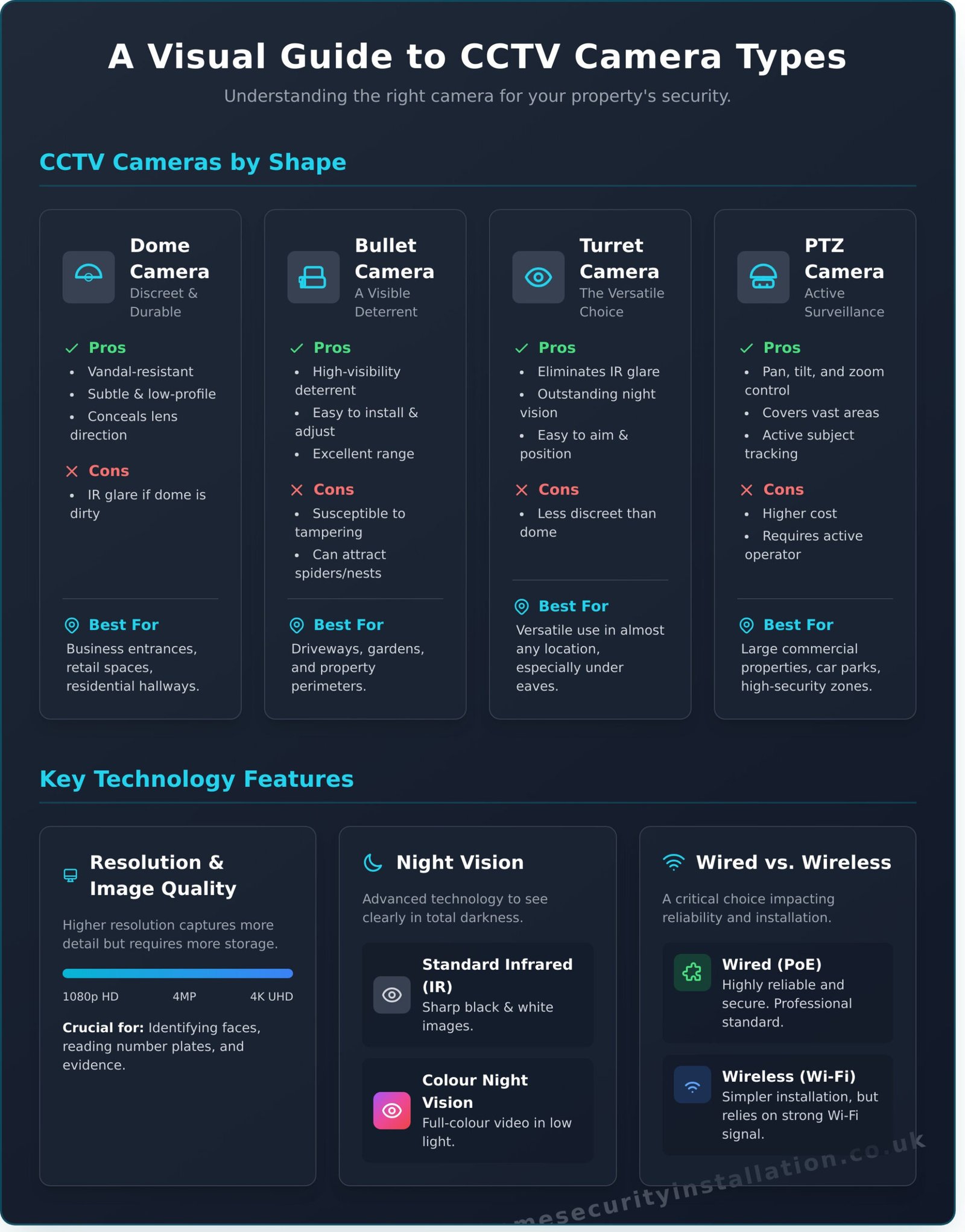
Dome cameras are named for their distinctive dome-shaped casing, which cleverly conceals the direction the camera lens is pointing. This ambiguity makes them an excellent choice for subtle surveillance. Pros: Their design is inherently vandal-resistant and discreet, making them suitable for both indoor and outdoor use in public-facing areas. Cons: The dome casing can sometimes cause infrared glare at night if it becomes dirty. Best for: Professional installation at business entrances, in retail spaces, and within residential hallways where a low-profile solution is preferred.
Bullet Cameras: A Visible Deterrent
With a distinctive cylindrical shape resembling a lipstick tube or bullet, these cameras are designed to be seen. Pros: Their high visibility acts as a powerful deterrent to potential intruders. They are also straightforward to install and adjust, often providing excellent range for monitoring long distances. Cons: Their prominent shape can make them more susceptible to tampering or even nesting spiders, which can obscure the view. Best for: Monitoring specific outdoor areas like driveways, gardens, and the perimeters of your property.
Turret Cameras (Eyeball Cameras): The Versatile Choice
Also known as eyeball cameras, turret cameras feature a flexible ball-and-socket design that separates the lens and infrared illuminators. Pros: This design completely eliminates the night-time glare issues associated with dome cameras and makes them incredibly easy to aim. Their night vision performance is typically outstanding. Cons: They are more visible than a dome camera, offering less discretion. Best for: A highly versatile and reliable option for almost any location, particularly under the eaves of a house or business.
PTZ (Pan-Tilt-Zoom) Cameras: Active Surveillance
PTZ cameras offer a dynamic approach to security, allowing an operator to remotely control the camera’s movement—panning horizontally, tilting vertically, and zooming in on specific details. Pros: A single PTZ camera can cover a vast area that might otherwise require multiple fixed cameras, and it allows for active tracking of subjects. Cons: They are a more significant investment and require a user or sophisticated software to be operated effectively. Best for: Large commercial properties, car parks, and high-security zones requiring active, responsive monitoring.
Key Technology Features That Define Modern CCTV
While the physical shape of a camera—be it a dome, bullet, or PTZ—is an important starting point, its true performance is determined by the technology inside. Understanding these core features is essential for choosing a system that provides reliable protection, day and night. When navigating the various types of cctv cameras, focusing on resolution, night vision, and connectivity ensures you invest in a solution that delivers clarity when it matters most. This is where professional advice is invaluable, guaranteeing your system is fit for purpose.
Resolution and Image Quality (HD to 4K)
Think of resolution as the difference between a blurry, indistinct photograph and a crystal-clear one. Measured in pixels, common resolutions include 1080p (Full HD), 4 Megapixels (4MP), and 8MP (4K Ultra HD). Higher resolution is crucial for capturing the fine details needed to identify faces, read vehicle number plates, or distinguish specific clothing. Capturing such clear footage is a key principle of the UK government’s Surveillance Camera Code of Practice. However, this superior quality comes with a trade-off: 4K footage consumes significantly more storage space. A professionally designed system will balance image clarity with efficient storage solutions.
Night Vision: Seeing in the Dark
Security threats don’t stop when the sun goes down, and neither should your cameras. Modern systems use advanced technology to see clearly in low-light and total darkness.
- Standard Infrared (IR): This technology uses built-in IR LEDs to illuminate an area, producing sharp black-and-white images even with no visible light.
- Advanced Colour Night Vision: Using highly sensitive sensors, these cameras can produce full-colour video in very low light conditions, providing far more detail for identification.
The ability to identify the colour of a vehicle or an intruder’s clothing can be critical for an investigation. Always check the camera’s specified IR effective range to ensure it can cover the entire area you need to protect.
Wired vs. Wireless Cameras: A Critical Decision
How a camera connects to your network is a fundamental choice that impacts reliability and installation. While both are effective types of cctv cameras, they suit different needs.
- Wired (IP/PoE): Considered the professional standard, these cameras use a single Ethernet cable for both power (Power over Ethernet) and a highly stable data connection. They are exceptionally reliable, secure, and not vulnerable to Wi-Fi signal fluctuations.
- Wireless (Wi-Fi): These cameras connect to your network via Wi-Fi, which simplifies installation in areas where running a data cable is impractical. However, they still require a separate power source and rely on a strong, consistent Wi-Fi signal to function correctly.
Understanding Camera Lenses and Field of View
Beyond the physical shape of the camera, the lens is the single most important component determining what your CCTV can see. The lens dictates the camera’s field of view—the width and height of the area it can monitor. Choosing the right lens is vital for effective surveillance; a mismatch can lead to critical blind spots or wasted coverage on irrelevant areas. When considering different types of cctv cameras, understanding the lens options is crucial. While many features are important, as detailed in The Independent’s guide to the best home security cameras, the lens directly impacts the system’s ability to protect your property. Let’s explore the two primary lens categories: fixed and varifocal.
Fixed Lenses (Wide-Angle)
A fixed lens, as the name suggests, has a set focal length and a non-adjustable field of view. A common example is a 2.8mm lens, which provides a wide, panoramic perspective. These are a standard, cost-effective choice for many security applications, delivering reliable performance without complexity.
- Pros: Simple, highly reliable, and excellent for capturing a general overview of a room, garden, or entryway.
- Cons: You cannot zoom in to focus on a specific point of interest. The view you see during installation is the view you will always have.
Varifocal Lenses (Adjustable Zoom)
Varifocal lenses offer superior flexibility, allowing you to manually or remotely adjust the zoom and focus. This adjustment is performed by a professional technician during installation to perfectly frame the desired view, whether that’s a narrow entrance or a broad car park.
- Pros: Highly adaptable and can be tailored to monitor a specific scene precisely, from a wide overview to a tight, zoomed-in shot.
- Cons: These lenses are more expensive than their fixed counterparts and require expert setup to achieve the optimal focus and field of view.
Matching the Lens to the Location
Selecting the right lens is a practical decision when choosing between different types of cctv cameras. A wider lens is not always better. Here are some common guidelines our certified engineers follow:
- Wide-Angle (e.g., 2.8mm): Ideal for covering small rooms, the area directly in front of your main door, or a small patio.
- Medium Lens (e.g., 4mm): A versatile choice for monitoring medium-sized spaces like a back garden, a typical driveway, or the side of a house.
- Telephoto Lens (e.g., 6mm+): Used for focusing on distant objects with clarity, such as a gate at the end of a long drive or a specific parking space.
Getting this balance right is key to creating a security system with no weak points. For complete peace of mind, it’s always best to have a professional assessment. Ask our experts for a free site survey.
Smart CCTV Features and Advanced Camera Types
Modern CCTV systems have evolved far beyond simple recording devices. Today’s advanced cameras are intelligent tools that actively analyse footage, providing a higher level of security and complete peace of mind. These smart features help to reduce false alarms and deliver meaningful, actionable alerts, transforming how we protect our homes and businesses. Understanding these capabilities is crucial when choosing between the various types of CCTV cameras available.
AI Analytics: From Motion Detection to Person Detection
Traditional motion detection would trigger an alert for any movement, from a passing animal to swaying tree branches. Modern AI (Artificial Intelligence) analytics provide a more intelligent solution. These systems can differentiate between people, vehicles, and other motion, ensuring you only receive alerts that truly matter. Key features include:
- Person & Vehicle Detection: Ignores irrelevant motion to focus on genuine security events.
- Line Crossing & Intrusion Detection: Allows you to create virtual boundaries on your property and receive an alert if they are crossed.
The primary benefit is a significant reduction in false notifications, providing you with more reliable and useful security information.
ANPR and LPR Cameras
ANPR (Automatic Number Plate Recognition), also known as LPR (License Plate Recognition), is a specialised technology designed to capture and read vehicle number plates. These cameras are not typically used for residential properties but are invaluable for commercial sites. They provide a reliable method for controlling access to car parks, monitoring site entrances, and managing vehicle flow automatically.
Multi-Sensor and Panoramic Cameras
For monitoring large, open areas, multi-sensor and panoramic cameras offer an efficient solution. By combining multiple lenses within a single housing, these advanced types of CCTV cameras can provide a seamless 180° or even 360° field of view. A single panoramic camera can often replace several standard cameras, reducing installation complexity and costs while eliminating blind spots. They are ideal for warehouses, large retail floors, and public squares where comprehensive coverage is essential.
Navigating these advanced options can be complex. For professional advice on the best security solution for your property, talk to one of our certified UK experts.
How to Choose the Right Types of CCTV for Your Property
Selecting the right CCTV camera involves more than simply picking a shape. The goal is to create a cohesive, reliable security system that covers your property’s unique vulnerabilities. An effective setup often uses a strategic mix of different camera models, each chosen for a specific task. To achieve complete peace of mind, professional installation ensures every component performs to its full potential, creating a seamless protection network.
Step 1: Identify Your Key Monitoring Zones
The first step is a thorough assessment of your property. Walk the perimeter and interior, thinking like an intruder to identify potential weak points. Consider the purpose of surveillance in each location.
- Key Areas: Note all entry points like front and back doors, ground-floor windows, driveways, and garden gates. Also, identify areas where valuables are stored or are out of sight.
- Lighting Conditions: Assess the natural and artificial light in each zone, both during the day and at night. This will determine the need for features like infrared or colour night vision.
- Surveillance Goal: Decide what you need each camera to achieve. Is it for general deterrence, providing an overview, or capturing clear facial details for identification?
Step 2: Match the Camera Type to the Zone
Once you understand your needs, you can select the best types of cctv cameras for each location. Matching the camera’s strengths to the zone’s requirements is crucial for effective coverage.
- Front Door: A turret or dome camera with high resolution and colour night vision is excellent for capturing clear facial images of visitors.
- Driveway or Garden: A bullet camera is ideal for monitoring long, narrow spaces. Its visible presence also acts as a powerful deterrent.
- Indoor Hallway: A compact indoor dome camera provides discreet monitoring without being obtrusive.
- Large Outdoor Area: For a commercial yard or large car park, a single PTZ camera can provide comprehensive coverage, allowing you to pan, tilt, and zoom to track activity.
Step 3: The Importance of a Professional Installation
Even the most advanced security cameras will underperform if installed incorrectly. A professional installation is a critical final step to guarantee your system’s reliability and effectiveness. An expert ensures optimal camera placement to eliminate blind spots, correctly configures lenses and smart features for peak performance, and uses secure, weatherproof cabling to protect the system’s integrity from the elements and tampering.
For the assurance that your property is properly protected, trust our certified installers to design your system.
Secure Your Property with the Right CCTV Solution
Choosing the ideal security camera for your UK property involves more than just its shape. As we’ve covered, key factors like lens type, technological features, and smart capabilities are what truly define an effective surveillance system. Understanding the different types of cctv cameras is the vital first step towards achieving robust protection and genuine peace of mind.
While this guide provides a strong foundation, navigating these options to create a tailored solution requires expertise. Since 1980, our certified UK security professionals have been designing and installing bespoke CCTV systems for homes and businesses, ensuring every angle is covered and every concern is addressed. We translate complex technology into reliable, everyday security you can count on.
Ready to make a confident choice for your property’s safety? Talk to a Security Expert About Your CCTV Needs today and let us help you build the perfect security solution.
Frequently Asked Questions
What is the difference between a DVR and an NVR?
The primary difference lies in how they process video data. A DVR (Digital Video Recorder) is used with analogue cameras and processes the video signal at the recorder itself. In contrast, an NVR (Network Video Recorder) works with IP (digital) cameras, where the video is encoded and processed at the camera before being sent to the NVR for storage. NVR systems generally offer higher resolution, greater flexibility, and are easier to scale for larger properties.
Do CCTV cameras record audio in the UK?
While some CCTV cameras have audio recording capabilities, it is legally complex in the UK. Recording conversations between members of the public, or of your neighbours in their garden, can be a criminal offence and a breach of data protection laws. For residential systems, it is strongly advised to disable audio recording to avoid invading privacy. Any use of audio recording must be clearly justified, proportionate, and accompanied by prominent warning signs to be legally compliant.
How long do CCTV systems typically store recorded footage?
Storage duration depends on the hard drive size, camera resolution, and number of cameras. A standard residential system with a 1TB hard drive recording from four 1080p cameras might store around one to two weeks of continuous footage. Most systems are set to a loop, automatically overwriting the oldest recordings once the drive is full. For specific security needs, larger hard drives can be installed to extend storage time to 30 days or more, ensuring critical evidence is retained.
Can modern CCTV cameras see in complete darkness?
Yes, most modern security cameras are equipped for night vision. They typically use built-in infrared (IR) LEDs to illuminate the area with light that is invisible to the human eye. This allows the camera to capture clear black-and-white images even in total darkness. More advanced models may feature ‘Starlight’ or ‘ColourVu’ technology, which use highly sensitive sensors to produce full-colour images in very low-light conditions, providing even greater detail for complete peace of mind.
What are the UK laws regarding residential CCTV cameras?
If your CCTV system captures images beyond your property boundary, such as a neighbour’s property or a public street, you are subject to the Data Protection Act and UK GDPR. You must have a clear and valid reason for recording, display clear signage to inform people they are being recorded, and ensure you are not capturing more footage than necessary. It is your responsibility to use your system in a way that respects the privacy of others and complies with the law.
Which type of CCTV camera is best for outdoors?
Bullet cameras are an excellent and popular choice for outdoor security. Their visible, elongated shape acts as a strong visual deterrent to potential intruders. They are specifically designed to withstand the elements, typically featuring a high IP rating (like IP67) for dust and water resistance. Their integrated sun shields also help to prevent glare, ensuring a clear picture in various weather conditions. For covering large areas like car parks or expansive gardens, a PTZ camera offers superior coverage.
Is 4K resolution really necessary for a home CCTV system?
While not strictly necessary for every home, 4K resolution provides significantly more detail than standard HD (1080p). This enhanced clarity is crucial for identifying distant faces, reading number plates, or zooming in on recorded footage without losing quality. For many properties, a 2MP (1080p) or 4MP system offers a perfect balance of clear imaging and efficient storage. When choosing between the different types of cctv cameras, consider the specific areas you need to protect to determine the best resolution.