The thought of UK fire safety regulations can be daunting for any business owner. Faced with a web of technical jargon, confusing categories, and the constant worry of non-compliance and potential fines, it’s easy to feel overwhelmed. If you’re responsible for a non-domestic property, the key standard you need to understand is BS 5839-1. But what does this code of practice actually mean for you, your building, and the people inside it? Getting it wrong isn’t just a compliance issue; it’s a critical safety risk that no one can afford to take.
Consider this your clear, straightforward guide. We’re here to cut through the complexity and demystify the rules once and for all. In this article, we’ll break down everything you need to know about designing, installing, and maintaining a compliant fire alarm system. You’ll gain a clear understanding of your legal obligations, learn the difference between system grades and categories, and feel confident in choosing the right protection for your property. Let’s give you the knowledge to protect your premises and, most importantly, your people.
What is BS 5839-1 and Who Must Comply?
BS 5839-1 is the definitive UK code of practice for the design, installation, commissioning, and maintenance of fire detection and fire alarm systems in and around non-domestic buildings. Its primary goal is to ensure these critical systems are fit for purpose, providing reliable and early warnings to save lives and protect property in the event of a fire.
While not a law in itself, it is the benchmark standard for fire safety in the UK. Complying with its recommendations is widely regarded as the best way to satisfy your legal obligations under the Regulatory Reform (Fire Safety) Order 2005. The standard, officially known as BS 5839 Part 1, provides the detailed technical guidance that building owners and designated ‘Responsible Persons’ need to ensure their fire safety measures are adequate and effective.
To see how these principles apply in practice, this video offers a clear explanation:
This standard applies to virtually all non-domestic premises where a fire could put people at risk. Compliance is essential for:
- Offices, shops, and retail outlets
- Factories and warehouses
- Schools, colleges, and universities
- Hospitals and care homes
- Hotels and guesthouses
- Public buildings like libraries, museums, and leisure centres
The Core Purpose: Life Safety vs. Property Protection
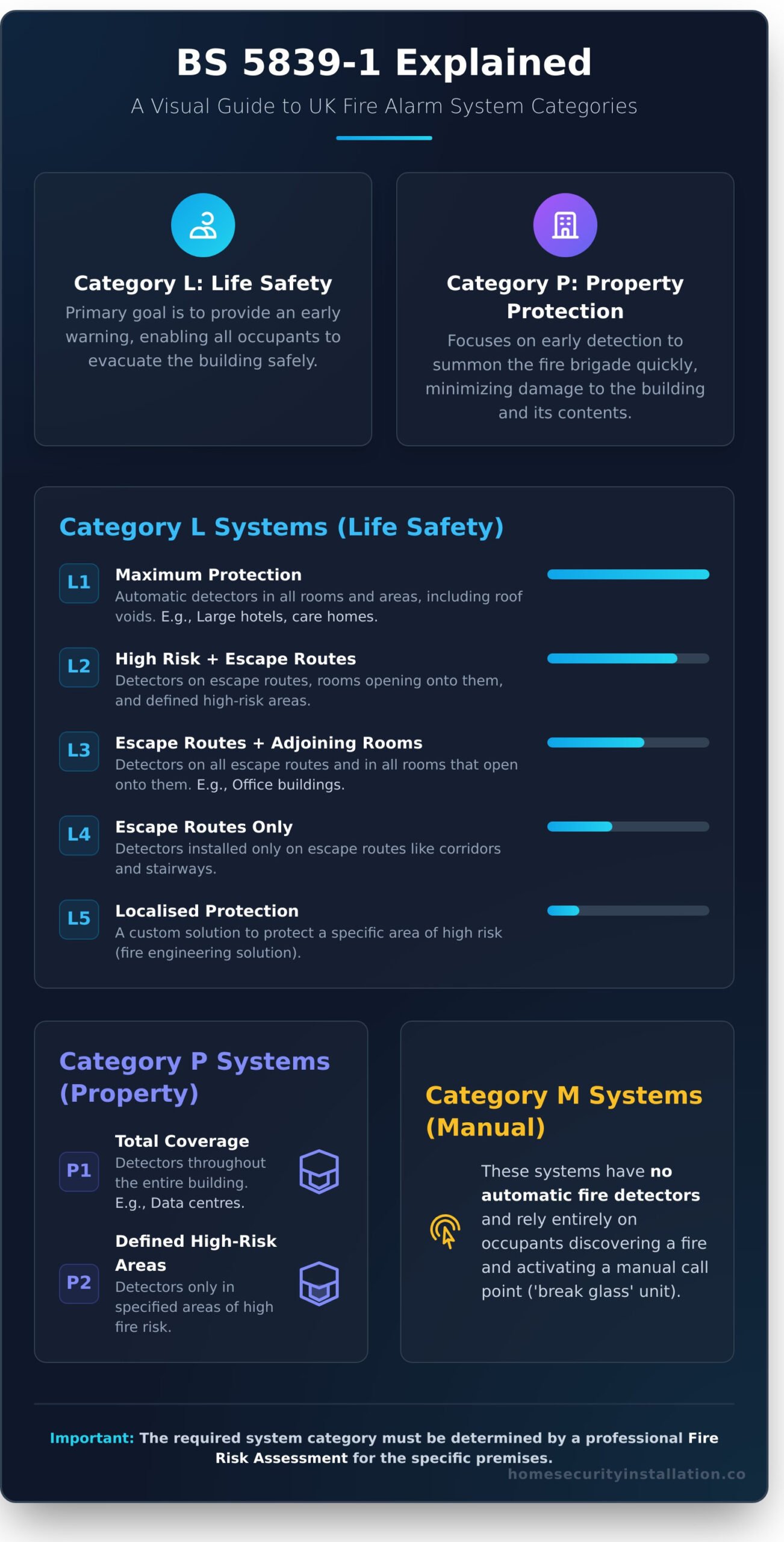
A fire alarm system designed to bs 5839 1 can have one or both of two primary objectives. Life Safety systems (Category L) are designed to provide a warning that enables all occupants to evacuate the building safely. Property Protection systems (Category P) focus on early detection to summon the fire brigade as quickly as possible, thereby minimising damage to the building, its contents, and business operations.
Key Differences from BS 5839-6 (Domestic Systems)
It’s crucial not to confuse this standard with BS 5839-6, which covers fire detection and alarm systems in domestic dwellings like houses and flats. Part 1 is significantly more stringent and detailed. This is due to the higher risks associated with commercial premises, such as larger building sizes, higher occupancy levels, and more complex evacuation procedures. A simple battery-powered smoke alarm suitable for a home is entirely insufficient for protecting a business.
Decoding Fire Alarm System Categories (L, P & M Systems)
Within the UK’s fire safety framework, the ‘Category’ of a fire alarm system defines its primary objective and the extent of its coverage throughout a building. The specific category required is not a one-size-fits-all solution; it is determined by a thorough fire risk assessment for the premises. The guidance laid out in the British Standard BS 5839-1 organises systems into three main types: L for the protection of Life, P for the protection of Property, and M for Manual systems.
| Category Type | Primary Purpose |
|---|---|
| L (Life) | To provide an early warning to building occupants, enabling a safe evacuation. |
| P (Property) | To detect a fire at the earliest stage and call the fire and rescue service, minimising damage. |
| M (Manual) | A system reliant on human detection, with no automatic fire detectors. |
Category L Systems: Protecting Life
Category L systems are the most common type and are fundamentally designed to save lives. Their main goal is to provide a warning early enough for everyone in the building to escape safely. The level of coverage varies across five sub-categories:
- L1 (Maximum Protection): Automatic detectors are installed in all rooms and areas, including roof voids and escape routes. Example: A large hotel or a care home.
- L2: Detectors are installed on escape routes, in rooms opening onto them, and in defined high-risk areas.
- L3: Detectors are installed on all escape routes and in rooms that open onto them. Example: An office building with multiple escape stairways.
- L4: Detectors are installed only on escape routes, such as corridors and stairways.
- L5 (Localised Protection): A system designed to protect a specific area of high risk, often part of a fire engineering solution.
Category P Systems: Protecting Property
The focus of a Category P system is asset protection. While it will alert occupants, its primary function is early fire detection to summon the fire and rescue service swiftly, thereby limiting potential damage to the building, its contents, and business operations. There are two levels:
- P1: Automatic detection is installed throughout the entire building, ensuring the earliest possible warning of a fire wherever it starts. Example: A critical data centre or a warehouse with high-value stock.
- P2: Automatic detection is installed only in defined areas of high fire risk or hazard.
Category M Systems: Manual Operation
A Category M system is the most basic fire alarm specified under bs 5839 1. It features no automatic fire detectors and relies entirely on occupants discovering a fire and activating the system by operating a manual call point (a ‘break glass’ unit). These systems are only appropriate for buildings where a fire is likely to be discovered by people quickly and where automatic detection is not deemed necessary by the fire risk assessment.
The Four Pillars of a BS 5839-1 Compliant System
Achieving compliance with bs 5839 1 is not simply about purchasing certified equipment. It’s a holistic process that ensures your fire alarm system is designed, fitted, and maintained to perform flawlessly when it matters most. This journey is built upon four critical pillars, each one essential for creating a truly reliable life safety system. These stages, detailed in the Official BS 5839-1 Standard, represent the professional service journey from initial concept to long-term protection.
Design: The Blueprint for Safety
Everything starts with a robust design, informed by a thorough fire risk assessment. This initial step determines the specific needs of your premises, dictating the system category required (e.g., L2 for life protection in defined escape routes, or P1 for property protection). A competent designer will create a detailed zone plan, allowing for the rapid identification of a fire’s location, and select the correct types of detectors and call points for different environments to minimise false alarms.
Installation: The Role of Competent Engineers
A flawless design is only effective if installed correctly. This stage demands precision and expertise from qualified technicians. Installation involves more than just mounting devices; it requires using fire-resistant cabling secured with appropriate fixings, ensuring the system can operate even during a fire. The correct placement of detectors, manual call points, and sounders is critical to guarantee early detection and clear audibility throughout the building, as mandated by the bs 5839 1 code of practice.
Commissioning & Handover: Proving it Works
Commissioning is the formal process of verifying that the installation meets the design specification and the standard’s requirements. A competent engineer will test every single component—from detectors and sounders to the control panel itself—to ensure full functionality. Upon successful completion, a formal handover provides you with essential documentation for legal and insurance purposes, including:
- Commissioning and installation certificates
- An official system logbook
- ‘As-fitted’ drawings and a zone plan
Maintenance: Ensuring Long-Term Reliability
A fire alarm system’s reliability depends on consistent upkeep. The standard outlines a dual responsibility: the designated ‘Responsible Person’ on-site should conduct weekly tests to check basic functions. However, a comprehensive service by a competent professional is required at least every six months. This service involves in-depth checks of all components to ensure the system remains fully compliant and operational for years to come. Need expert fire alarm maintenance? Learn about our servicing plans.
Essential Components of a Commercial Fire Alarm System
A commercial fire alarm system is more than just a collection of bells and detectors; it’s a sophisticated network designed to save lives and protect property. Think of it as the building’s central nervous system, constantly sensing for danger and ready to react instantly. Every component plays a vital role in meeting the stringent requirements of bs 5839 1, working in harmony to provide a rapid, reliable warning.
The Control Panel (FACP): The System’s Brain
At the heart of any system is the Fire Alarm Control Panel (FACP). This is the ‘brain’ that monitors all connected devices, processes information, and makes critical decisions. It continuously checks for signals from detectors and, if a fire is detected, it activates the sounders and beacons. Panels come in two main types:
- Conventional Panels: These divide the building into broad zones. An activation tells you the fire is in a specific zone (e.g., ‘the first floor’), but not the exact device. They are simpler and suited for smaller premises.
- Addressable Panels: Each detector and call point has a unique address. If one is activated, the panel pinpoints the exact location (e.g., ‘smoke detector in Office 3’). This allows for a much faster investigation and response.
Detection Devices: The ‘Nose’ and ‘Eyes’
These are the sensory organs of your fire alarm system, constantly on the lookout for the first signs of fire. The type of detector used is critical for effectiveness and preventing false alarms. Common types include:
- Smoke Detectors: Typically optical, these ‘see’ smoke particles in the air and are ideal for offices, corridors, and escape routes.
- Heat Detectors: These devices react to a rapid rise in temperature. They are the ‘nose’ for heat and are best for environments like kitchens or dusty workshops where smoke detectors might trigger falsely.
- Manual Call Points: These red ‘break glass’ units are the human element, allowing anyone who spots a fire to manually trigger the alarm system immediately.
Alarm Devices: The ‘Voice’
When the FACP confirms a fire, it uses alarm devices to alert everyone in the building. This is the system’s ‘voice’, and it must be clear and unmissable. These include audible alarms like electronic sounders or bells, which must be loud enough (at least 65 decibels) to be heard above ambient noise. For noisy areas or to ensure accessibility for the hearing impaired, visual alarm devices (VADs) like flashing beacons are essential. For ultimate protection, the system can be monitored, sending a signal to an Alarm Receiving Centre (ARC) which then contacts the fire brigade on your behalf.
Ensuring these components are correctly specified and installed is crucial for compliance and safety. For expert advice on a system design that fully complies with bs 5839 1, contact our team of specialists.
Why Professional Design and Installation is Crucial
Understanding the requirements of BS 5839-1 is one thing; implementing them correctly is another. A fire alarm system is not a simple off-the-shelf product but a life-safety solution where compliance is a continuous process. Attempting to cut corners with DIY or unqualified installations exposes your business to severe risks, including hefty legal penalties, invalidated insurance policies, and, most critically, the potential loss of life.
The complexity of the standard demands expert interpretation. A professional ensures that every component, from detectors to sounders, is correctly specified, positioned, and commissioned to function as a cohesive system when it matters most.
The Dangers of DIY or Unqualified Installation
An incorrectly installed system offers a false sense of security. Common mistakes include placing a smoke detector in a kitchen’s steamy environment, leading to constant false alarms, or using standard PVC cables instead of fire-rated ones that are designed to withstand extreme heat. If the cabling fails during a fire, the entire system becomes useless. Ultimately, without the correct design, installation, and commissioning certificates from a competent person, your system is not legally compliant.
Choosing a Competent Fire Alarm Company
Entrusting your fire safety to a proven expert is non-negotiable. When vetting potential installers, look for clear indicators of their competence and commitment to the rigorous standards of bs 5839 1. Here’s what to check for:
- Third-Party Certification: Prioritise companies accredited by a UKAS-certified body like BAFE (British Approvals for Fire Equipment) or NSI/SSAIB. This is your best guarantee of quality and compliance.
- Relevant Experience: Ensure they have a track record of installing systems in properties similar to yours, whether it’s a complex office block, a warehouse, or a residential care home.
- Comprehensive Documentation: A professional firm will provide all necessary paperwork, including design, installation, and commissioning certificates, plus a system logbook.
- Ongoing Support: A compliant system requires regular maintenance. Check that they offer service contracts to keep your system in perfect working order.
Navigating fire alarm regulations can be challenging, but our team makes it simple. We are experts in designing and installing fully compliant fire alarm systems. Request a free site survey today.
Your Path to BS 5839-1 Compliance and Total Peace of Mind
Navigating UK fire alarm regulations doesn’t have to be a complex challenge. The key takeaways are clear: understanding your required system category (L, P, or M) is vital, and professional expertise is non-negotiable for ensuring both safety and legal compliance. A correctly designed and installed system is your first and most effective line of defence against the devastating impact of fire.
Meeting the stringent requirements of bs 5839 1 is more than a tick-box exercise; it’s a fundamental commitment to protecting lives, property, and your business continuity. Don’t leave this critical responsibility to chance.
With decades of experience since 1980, our BAFE accredited fire system installers provide comprehensive design, installation, and maintenance services you can trust. Let our experts handle the complexities for you. Ensure your property is safe and compliant. Request a free, no-obligation fire safety survey today.
Taking proactive steps towards fire safety is one of the most important decisions you can make.
Frequently Asked Questions about BS 5839-1
What is the main difference between BS 5839-1 and BS 5839-6?
The primary difference is the type of property each standard covers. BS 5839-1 applies to non-domestic, commercial premises such as offices, factories, and schools. It details the requirements for more complex systems. In contrast, BS 5839-6 is the code of practice for fire detection and alarm systems in domestic dwellings, including houses, flats, and HMOs. In short, Part 1 is for commercial buildings, while Part 6 is for homes.
Is BS 5839-1 a legal requirement in the UK?
While BS 5839-1 itself is a code of practice and not a law, compliance is effectively mandatory. The Regulatory Reform (Fire Safety) Order 2005 is the law, and it requires the ‘Responsible Person’ for a building to ensure adequate fire safety measures are in place. Following the guidance in BS 5839-1 is the universally accepted method to prove your fire detection and alarm system meets this legal obligation, making it an essential standard to adhere to.
How often does a commercial fire alarm system need to be serviced under BS 5839-1?
BS 5839-1 recommends that a competent professional should service your commercial fire alarm system at least every six months. The interval between these biannual service visits should not exceed six months to ensure the system remains reliable and compliant. This is in addition to weekly user tests, such as activating a manual call point, which should be recorded in a logbook. These regular checks are crucial for maintaining system integrity and ensuring early fault detection.
What is a fire alarm zone plan and why do I need one?
A fire alarm zone plan is a simple diagrammatic map of your building, located next to the main fire alarm control panel. Its purpose is to show the different fire detection zones, helping building managers and the fire brigade to quickly identify the precise location of a fire. This is critical for enabling a rapid and effective response in an emergency. BS 5839-1 mandates that a zone plan is required for all but the smallest systems.
Can my existing fire alarm system be upgraded to meet BS 5839-1?
Yes, in most cases, an existing fire alarm system can be upgraded to meet current standards. A qualified engineer will need to conduct a full site survey to assess your current components against the latest recommendations. They can then advise on necessary upgrades, which might include adding more detectors for better coverage, replacing an outdated panel, or installing improved sounders. This ensures your system fully complies with the latest bs 5839 1 guidelines for maximum safety.
What happens during a professional fire alarm service visit?
During a service visit, a qualified engineer will carry out a series of checks to ensure your system is functioning correctly. This includes testing a percentage of all devices like smoke detectors and call points, checking the standby battery power, and verifying the connection to any alarm receiving centre. The engineer will also review the logbook for any issues and provide a detailed service report, confirming the system’s operational status and highlighting any required remedial actions.