Choosing the right security system for your home is one of the most important decisions you can make. Yet, it often comes with a host of questions. Will the installation process be disruptive? Which system is truly more reliable and less prone to frustrating false alarms? The central debate often comes down to the choice of a wired vs wireless burglar alarm, leaving many homeowners feeling uncertain about which path provides the most robust protection. Concerns about intruders cutting wires or jamming signals are valid, and understanding these vulnerabilities is key to making a confident choice.
This expert comparison is designed to provide the clarity you need. We will break down the distinct advantages and disadvantages of both wired and wireless systems, from installation and maintenance to long-term costs and overall security. Our goal is to equip you with professional, straightforward insights, allowing you to select the ideal alarm that fits your property, budget, and security requirements. By the end of this guide, you will have the confidence to invest in a solution that delivers what matters most: complete peace of mind.
Understanding the Core Technology: How Do They Work?
To make the right choice in the wired vs wireless burglar alarm debate, it is essential to first understand how each system protects your property. Both systems rely on a network of sensors—placed on doors, windows, or to detect motion—that report back to a central control panel. This panel is the brain of your security system, designed to trigger an alarm and alert you or a monitoring centre to a potential intrusion.
The fundamental difference between the two lies in how these components “talk” to each other. For a detailed overview of the core components, you can learn more about How security alarms work, but the key distinction is straightforward. A simple analogy is a landline telephone versus a modern mobile phone: both achieve the same goal, but one uses a physical cable while the other uses secure radio waves. This single difference has significant implications for installation, flexibility, and maintenance.
The Traditional Choice: Wired Burglar Alarms
A wired alarm system uses physical, low-voltage cables to connect each sensor directly to the control panel. Our certified professionals install these wires discreetly within walls, ceilings, or under floorboards, creating a permanent and exceptionally reliable connection. The control panel is powered by your home’s mains electricity and includes a rechargeable battery backup, ensuring your property remains protected even during a power cut. This is the classic, robust approach to home security, valued for its unwavering stability and long-term performance.
The Modern Standard: Wireless Burglar Alarms
As the name suggests, a wireless burglar alarm uses advanced and secure radio frequency (RF) technology for communication. Each battery-powered sensor transmits an encrypted signal to the control panel, eliminating the need for extensive and disruptive wiring. This modern approach offers incredible flexibility, allowing sensors to be placed in optimal locations without being limited by cable runs. The speed of installation is also a major advantage, making it a popular choice for homes and businesses across the UK seeking effective, adaptable protection.
Head-to-Head Comparison: Key Factors to Consider
Choosing the right burglar alarm is a critical step in securing your property. The decision in the wired vs wireless burglar alarm debate often comes down to your specific home, budget, and long-term security goals. To provide complete clarity, we’ve compared these systems across the four most important factors for any homeowner.
Reliability and Performance
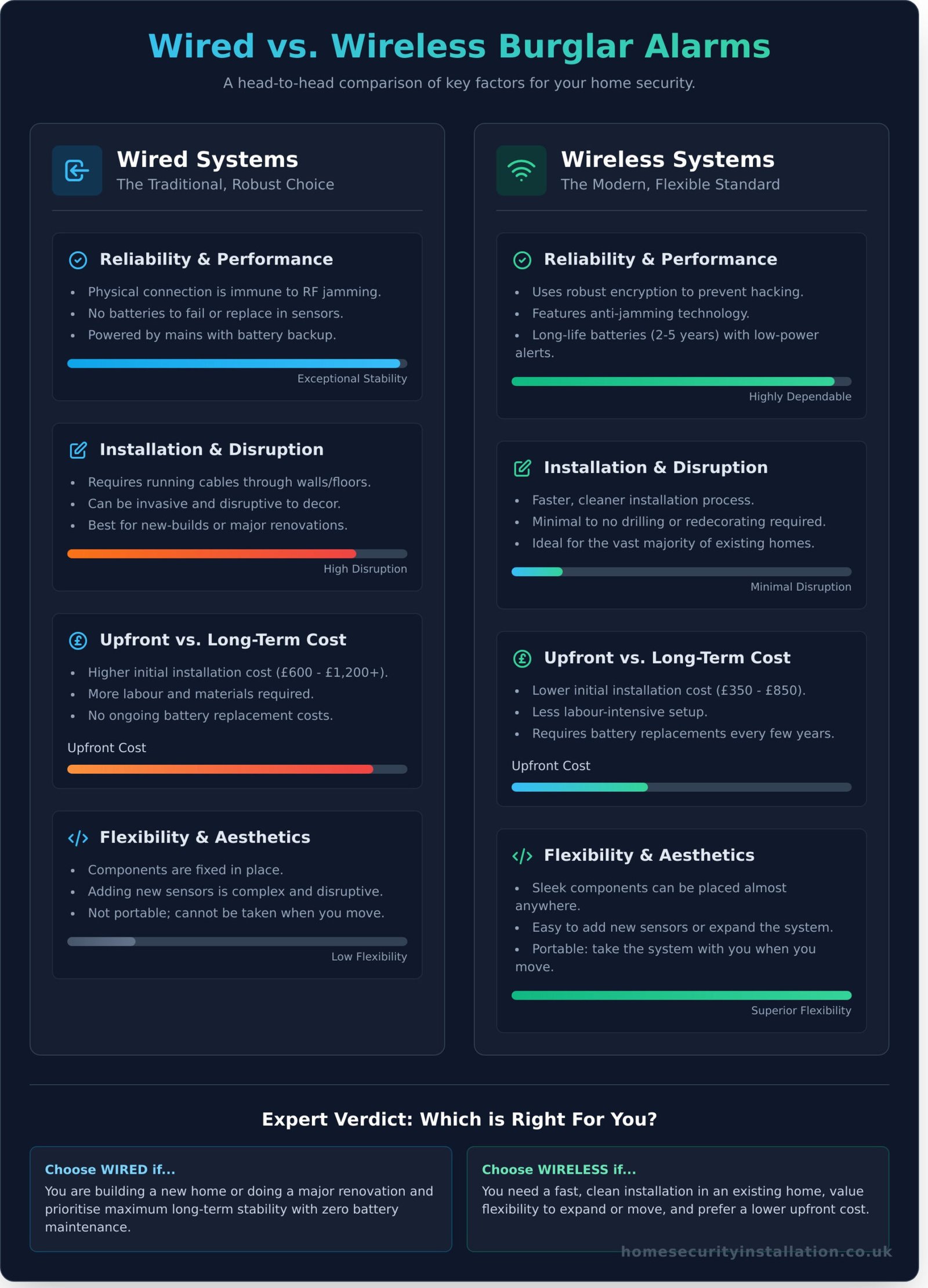
Wired alarms have a long-standing reputation for being exceptionally reliable. Hardwired connections are immune to radio frequency (RF) interference and don’t rely on batteries, eliminating the risk of a sensor failing due to power loss. However, modern wireless technology has all but closed this gap. Professional-grade wireless systems now feature robust encryption to prevent hacking, long-life batteries (lasting 2-5 years), and crucial supervision features that alert you well before a battery runs out. As highlighted in CNET’s guide to home security systems, many leading wireless options also include sophisticated anti-jamming technology to ensure a stable and secure connection.
Expert Verdict: Both systems are exceptionally reliable when professionally installed and maintained. The choice is less about which is more reliable overall, and more about which type of reliability suits your property.
Installation Process and Disruption
The installation process is where the two systems differ most significantly. A wired system requires our certified engineers to run cables from each sensor back to the main control panel. This can be an invasive process, often requiring drilling and lifting floorboards, making it best suited for new-build properties or homes undergoing major renovation. In contrast, a wireless system offers a much faster, cleaner installation with minimal disruption to your decor, making it the preferred choice for most existing homes.
Expert Verdict: For speed, convenience, and protecting your interior design in an existing home, wireless systems are the clear winner.
Cost: Upfront vs. Long-Term
Wired systems typically involve a higher initial installation cost, primarily due to the increased labour and materials required to run the cabling (often in the range of £600 – £1,200+). Wireless systems are generally more affordable upfront (typically £350 – £850) because installation is much quicker. However, it’s important to consider long-term costs. Wireless sensors require battery replacements every few years, a cost that can be managed and covered within one of our comprehensive maintenance contracts.
Expert Verdict: Wireless is often more budget-friendly at the outset. A wired system may prove more economical over a 10+ year lifespan due to the absence of battery costs.
Aesthetics and Flexibility
If you anticipate your security needs changing or plan to move in the future, wireless technology offers unparalleled flexibility. The sleek, modern components can be placed almost anywhere and it’s simple to add new sensors to cover a new extension or outbuilding. You can even take the system with you when you move. Wired components are fixed in place, and adding a new sensor later can be as disruptive as the initial installation.
Expert Verdict: Wireless systems offer superior flexibility, scalability, and a more discreet aesthetic, making them the ideal choice for the modern home.
Security & Maintenance: Which System Is Safer and Easier to Live With?
When considering the wired vs wireless burglar alarm debate, reliability is only the first step. True security comes from understanding how a system withstands potential threats and how easily it integrates into your daily life. A professionally installed system, whether wired or wireless, is designed to be highly resilient. Let’s explore the key differences in security and maintenance to give you complete peace of mind.
Vulnerability to Tampering
A common concern with any security system is whether an intruder can disable it. Both wired and wireless systems have robust, professional-grade countermeasures against tampering.
- Wired Systems: The primary theoretical risk is an intruder cutting the main power or phone line before entry. However, all modern, professionally installed systems include a backup battery and a secure cellular communicator. This ensures the alarm remains powered and can send an alert to a monitoring station, even if your landline and mains power are compromised.
- Wireless Systems: The concern here is signal jamming, where an intruder uses a device to block the radio frequency signals between the sensors and the main control panel. Professional wireless alarms feature advanced anti-jamming detection. If the system detects a jamming attempt, it will trigger an alarm immediately. To understand the basics of this communication, HowStuffWorks explains how burglar alarms work and the principles behind their signals.
Crucially, when installed to British Standards (BS EN 50131), both system types are exceptionally secure against tampering.
Power Cuts and Connectivity
Your alarm system must function when you need it most, including during a power outage. Both systems are designed for this scenario. A mandatory backup battery keeps the system running for at least 12 hours after a power cut. While wired systems are inherently immune to network or Wi-Fi outages, it’s a common myth that wireless alarms depend on your home Wi-Fi. In reality, they use their own dedicated and secure radio frequency. For ultimate protection, both can be equipped with a cellular backup to ensure the alarm signal always reaches the monitoring centre.
Ongoing Maintenance Requirements
The long-term upkeep is a key factor in the wired vs wireless burglar alarm decision. Each system has different, but manageable, maintenance needs.
- Wired Systems: These are famously low-maintenance. With no batteries in the sensors to worry about, they require very little attention beyond an annual professional service to check all connections and components are functioning perfectly.
- Wireless Systems: The main task is replacing the batteries in the sensors and detectors. These high-quality lithium batteries typically last between 2 to 5 years, and your system will provide you with low-battery warnings well in advance, ensuring you are never left unprotected.
For total peace of mind, you can ask about our annual maintenance plans, which cover both system types and ensure your property remains safe and secure year-round.
The Hybrid Approach: The Best of Both Worlds
When considering a wired vs wireless burglar alarm, many property owners believe it’s an ‘either/or’ decision. However, for a truly tailored and professional-grade security system, the optimal choice is often a combination of both. Hybrid systems represent the pinnacle of modern security technology, offering a flexible and robust solution that our certified experts frequently recommend for achieving complete peace of mind.
This approach moves beyond a simple choice, allowing for a security installation that is perfectly matched to the unique layout and requirements of your home or business. It provides a level of customisation that is simply not possible with a purely wired or wireless system alone.
What is a Hybrid Burglar Alarm?
A hybrid burglar alarm is an integrated system that combines the strengths of both wired and wireless technologies. The core components, such as the main control panel, keypad, and external sounder, are typically hardwired. This ensures they have a constant, reliable power supply and a secure connection. The system’s flexibility comes from using wireless sensors, such as PIR motion detectors and door contacts, which can be placed precisely where needed without disruptive cable runs.
Key Advantages of a Hybrid System
Opting for a hybrid system provides a powerful set of benefits, blending steadfast reliability with unmatched installation flexibility. This is why it is the preferred choice for complex or evolving properties across the UK.
- Uncompromising Reliability: It combines the rock-solid dependability of a wired core with the convenience and adaptability of wireless peripherals.
- Seamless Scalability: A hybrid system is the perfect solution for extending an existing wired alarm. If you’ve built a new extension, conservatory, or a detached garage, wireless sensors can be added easily without major rewiring.
- Enhanced Protection: You can integrate essential hardwired devices like smoke or carbon monoxide detectors with flexible, wireless intruder sensors, creating a comprehensive life safety and security system.
- The Ultimate Custom Fit: For properties with a mix of solid walls, decorative interiors, or outbuildings, a hybrid solution offers the ultimate customised protection, ensuring every potential vulnerability is covered.
Ultimately, the debate over a wired vs wireless burglar alarm is best resolved by a professional assessment of your property. A hybrid system often provides the most effective and future-proof answer. To find out how a tailored security solution can protect your property, talk to one of our security experts today.
Our Expert Recommendation: Which Alarm is Right for You?
After comparing the features, benefits, and drawbacks, the final decision in the wired vs wireless burglar alarm debate comes down to your unique property and circumstances. To help guide you, our experts have outlined recommendations based on the most common scenarios we encounter. This will help you identify the best starting point for securing your property and achieving complete peace of mind.
For New Builds and Major Renovations
If you are building a new home or undertaking a significant renovation, we strongly recommend a wired or hybrid security system. With walls and floorboards exposed, our certified engineers can run all necessary cabling discreetly and cost-effectively. This approach provides a robust, future-proof foundation for your security that requires minimal long-term maintenance, offering unparalleled reliability for years to come.
For Existing Homes and Listed Buildings
For most existing homes, a professional wireless or hybrid alarm system is the ideal choice. The primary advantage is the speed of installation and the minimal disruption to your home’s decor, as there is no need to run new cables through walls. This makes wireless technology particularly suitable for listed buildings or properties with features like solid stone walls, where running cables would be impractical or prohibited.
The Final Verdict: A Professional Survey is Key
While these guidelines are a helpful starting point, every property has its own distinct layout, potential weak spots, and security challenges. A generic, off-the-shelf solution can never provide the same level of protection as a professionally designed system. The only certain way to determine the perfect security solution is with a comprehensive site survey conducted by a qualified expert.
Our experienced technicians will assess your property, identify vulnerabilities you may not have considered, and listen to your specific concerns. Based on this detailed evaluation, we can recommend the ideal wired, wireless, or hybrid solution tailored precisely to your needs and budget. This professional approach ensures your property is safe and secure, giving you the confidence you deserve.
Take the next step towards securing your home. Request a free, no-obligation security survey today.
Your Final Step to Complete Peace of Mind
Choosing between security systems is a significant decision. As we’ve explored, traditional wired alarms offer rock-solid reliability, while wireless systems provide modern flexibility and easier installation. For many properties, a hybrid solution presents the perfect compromise. Ultimately, the right answer in the wired vs wireless burglar alarm debate is the one perfectly matched to your property and security needs.
You don’t have to make this choice alone. Since 1980, our certified UK security professionals have designed tailored solutions that protect homes and businesses across the country. We take the guesswork out of security to deliver a reliable system built for your specific requirements, giving you complete peace of mind. Ready to secure your property with confidence? Talk to a security expert to find the perfect alarm for your home.
Frequently Asked Questions
Can a wireless burglar alarm be jammed by intruders?
While basic, off-the-shelf wireless alarms can be vulnerable to jamming, professional-grade systems incorporate advanced anti-jamming technology. These reliable systems operate on multiple frequencies and use sophisticated signal encryption. If the system detects a deliberate attempt to jam its signal, it will immediately trigger an alarm, ensuring your property remains secure. This provides a robust layer of protection and complete peace of mind, neutralising the threat of signal jamming.
How long do the batteries last in a wireless alarm system?
The high-quality lithium batteries used in modern wireless sensors are designed for longevity, typically lasting between two and five years depending on the device and its usage. Your system provides advanced notice, sending a low-battery notification to the main control panel and often to your smartphone well before the battery is depleted. This ensures there are no gaps in your protection and allows for timely, non-urgent replacement by a certified professional.
What happens to a burglar alarm during a power cut?
Both wired and wireless alarm systems are designed to remain fully operational during a power cut. The main control panel for each system contains a rechargeable backup battery that automatically takes over, typically providing power for at least 12 hours. Since wireless sensors run on their own long-life batteries, the entire system continues to protect your property without interruption, ensuring your security is never compromised by a mains power failure.
Is a wired alarm system more secure than a wireless one?
Historically, wired systems were considered the benchmark for security. However, modern wireless technology has closed this gap entirely. Advanced wireless alarms now feature high-level encryption and anti-jamming detection, offering security on par with their wired counterparts. The debate of wired vs wireless burglar alarm systems today is less about security and more about the suitability for your property, installation flexibility, and aesthetic preferences. Both provide exceptional, reliable protection when professionally installed.
Can I add more sensors to my alarm system later on?
Yes, expanding your system is a straightforward process. Wireless alarm systems offer the greatest flexibility, allowing a certified engineer to add new sensors quickly with minimal disruption. While adding sensors to a wired system is also possible, it can be a more involved process that requires running new cables to the desired locations. We can advise on the best approach to ensure your system grows with your security needs.
Will a new alarm system affect my home insurance premium?
Installing a professionally certified burglar alarm system is highly regarded by UK insurance providers and can often lead to a reduction in your home insurance premium. Insurers typically offer discounts for systems that are installed and maintained by an accredited company, such as those certified by the NSI or SSAIB. We recommend informing your provider once your new system is active to see what savings you may be entitled to.